
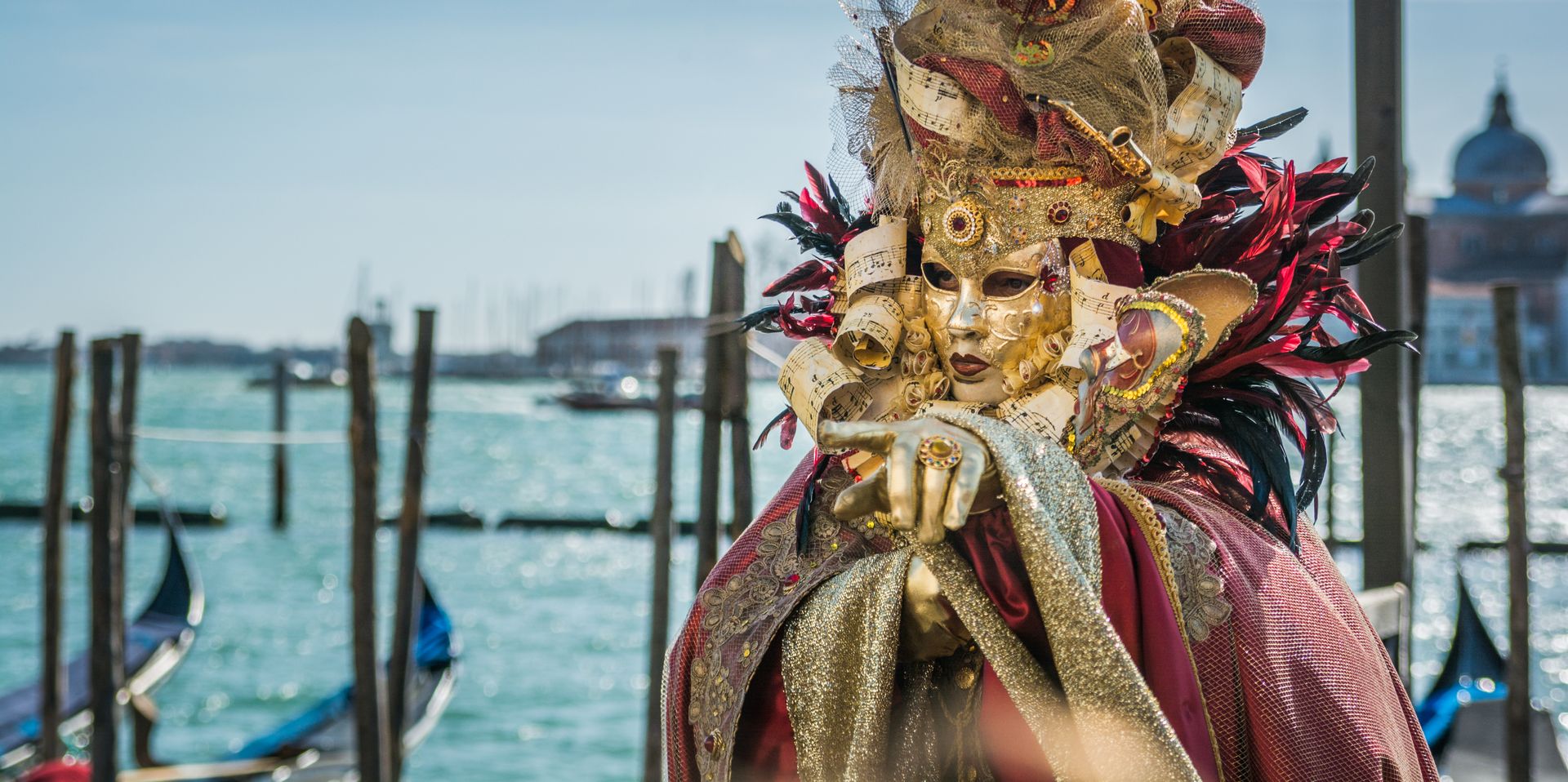
Venice Carnival: Origins, History and Masks
The Venice Carnival began in 1162 to commemorate the victory of the Republic of Venice over its adversary, the Patriarch of Aquileia.
Venetians gathered in St. Mark's Square to dance and celebrate their victory.
As time passed, the Carnival came to be celebrated for its own sake, and most revellers had no idea how it began.
Venice embraced traditional Greek and Roman holidays to satisfy the aspirations of the Venetian Republic, which pushed the Carnival to provide a time of joy and celebration for the people, especially the poorer classes.
Venice Carnival through the centuries
The Venice Carnival became a tradition in the seventeenth century.
At that time the famous Carnival of Venice gained international recognition: the effervescent and transgressive attitude, the comedy, the masks, the magnificent shows and the public gambling house made Venice "Europe's magnet".
The intent of the Carnival, an opportunity to vent tensions and discontent, soon had the opposite effect: the ability to completely conceal one's identity in traditional costumes and fancy masks made it the perfect setting for theft and harassment of various kinds.
These huge excesses led the Venetian Republic to enact a series of restrictions prohibiting the misuse and fraudulent use of masks and costumes, measures that gradually eroded the essential core of the Carnival and its original freedom.
The masks of the Venice Carnival
Masks have always been an essential component of the Venetian Carnival, which started as a time of celebration when all social classes would mingle. Wearing a mask offered the possibility to remain anonymous and enjoy the advantages that this brought with it.
In a society where social classes were very well defined and not intended to interact with each other, wearing a mask made it possible to hide any form of identification based on origin, age, gender or religion.
In 1436, the masters of the Guild of Decorators in Venice reorganised the mask making industry. They proposed a number of rules that were ratified by the Giustizieri Vecchi, the magistrates then responsible for overseeing the arts and crafts. This was when the Venetian profession of maschereri or mascareri (mask makers) was officially recognised, with its own guild and statutes.
The Venice Carnival masks gave complete anonymity, a kind of social levelling that allowed citizens to publicly criticise authority and nobility on occasion.
These freedoms provided an outlet for the social tensions and ill will caused by the severe moral and public order constraints of the Republic of Venice.
The Venice Carnival today
Only in 1967 were the first celebrations reconstructed, with parades of masks and costumes reviving the customs and history of the Venice Carnival.
For the first time, in 1979, a programme to involve Venetians in the festivities was devised in order to return the Carnival of Venice to its origins. And the new formula is a complete success story.
Plan your next programme with us: discover Venice and Corporate Events.